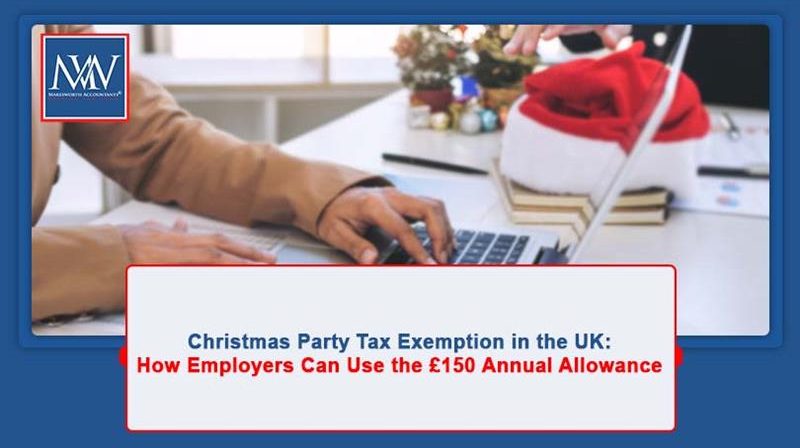
Christmas Party Tax Exemption in the UK: How Employers Can Use the £150 Annual Allowance
Many businesses organise a social gathering for employees during the festive season. This could be a traditional Christmas party or dinner, or something a little different such as a cocktail evening or a creative activity like wreath-making. While these events help boost morale and team spirit, it’s essential to understand the tax and National Insurance implications before finalising the plans.
HMRC does offer a specific tax exemption for annual staff parties and similar functions. However, this exemption only applies if certain conditions are met. Planning with these rules in mind can help employers avoid unexpected tax charges for their employees.
When Does the Tax Exemption Apply?
For a Christmas party or social function to qualify for the exemption, it must meet both of the following conditions:
-
It must be an annual event, and
-
It must be open to all employees, or to all employees at a particular workplace or location.
If there is only one qualifying annual event during the tax year, the cost per person must not exceed £150. Where more than one annual event is held, the total combined cost per head across all events must stay within the £150 limit for the exemption to apply.
The cost per head is calculated by dividing the total cost of the event — including any transport provided — by the total number of attendees. This includes both employees and any guests they bring.
Key Points Employers Should Watch Out For
Only events that take place every year qualify for the exemption. A one-off celebration, even if it is open to all staff and costs less than £150 per head, will not be exempt from tax.
The event must also be genuinely available to all employees (or all staff at a specific location). HMRC has confirmed that departmental events can qualify, but functions restricted to senior staff only do not meet the criteria.
When calculating the £150 limit, VAT must be included, even if it is later reclaimed. Guests must also be included in the headcount. Importantly, if the cost per head exceeds £150, the entire amount becomes taxable, not just the excess.
For example, if an employee attends with a guest and the cost per head is £160, the employee will be taxed on the full £320, not just the amount above £150.
Managing Multiple Events in One Tax Year
If more than one annual function is held during the year, the exemption can still apply as long as the combined cost per head across all events does not exceed £150.
If the limit is exceeded, the employer can choose which events benefit from the exemption. When making this decision, it’s wise to consider guest attendance. An event costing £100 per head for employees only may be more tax-efficient to exempt than an £80 per head event where employees bring partners, as the taxable value in the latter case could be higher.
Using a PAYE Settlement Agreement (PSA)
Where a Christmas event does not qualify for the exemption — for example, if it is not annual — the employee will face a benefit-in-kind tax charge based on the cost per head, including guests. The employer will also be liable for Class 1A National Insurance.
To preserve the goodwill associated with the event, many employers choose to include the benefit in a PAYE Settlement Agreement (PSA). This allows the employer to settle the tax liability on behalf of employees, ensuring the festive celebration remains just that — festive.
For more information, Book a Free Consultation
Need Accountancy Support?
For information on bespoke training, or if you have any other questions for Makesworth Accountant, please fill in your details below
Accountancy Support
Proud to be featured in




 150
150