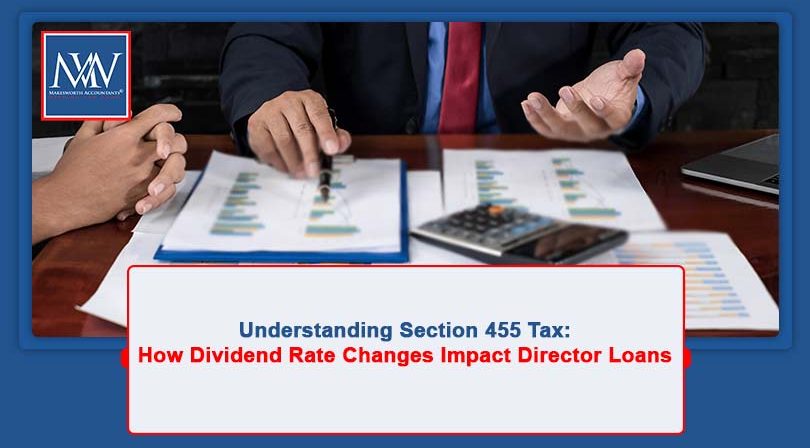
Understanding Section 455 Tax: How Dividend Rate Changes Impact Director Loans
What is Section 455 Tax?
In many personal and family-run companies, it’s common for director-shareholders to borrow money from their business. However, when the company is classified as a close company (which most family businesses are), there are tax implications if that loan isn’t repaid on time.
If the loan remains unpaid by the corporation tax due date—nine months and one day after the end of the accounting period—the company must pay an additional tax on the outstanding balance. This is known as Section 455 tax.
Is Section 455 Tax Permanent?
Unlike corporation tax, Section 455 tax is temporary. Although it must be paid alongside corporation tax, it can be reclaimed later.
The company becomes eligible for a refund nine months and one day after the end of the accounting period in which the loan is fully repaid. This means the tax is essentially a timing cost rather than a permanent expense.
Section 455 Tax Rates and Upcoming Changes
The rate of Section 455 tax is directly linked to the dividend upper tax rate.
- 2025/26 tax year: 33.75%
- 2026/27 tax year: 35.75%
This increase means that loans taken in later periods could result in a higher temporary tax charge.
Why Timing Matters for Director Loans
If a director is planning to take a loan and expects it to remain unpaid beyond the nine-month window, the timing of when the loan is taken becomes important.
For example, taking a loan before April 2026 instead of after could reduce the Section 455 tax liability by 2%. While the tax is refundable, it still impacts short-term cash flow.
Smart Strategy: Clearing Loans Efficiently
When repaying multiple director loans, it’s wise to prioritise those that were subject to higher Section 455 tax rates. Doing so allows the company to recover a larger amount of tax sooner, improving cash flow.
Example: How Timing Affects Tax Liability
Let’s break this down with a simple example:
- A company prepares accounts to 30 June each year
- The director plans to take a £30,000 loan and repay it in 2028
- The loan will still be outstanding when corporation tax is due
Scenario 1: Loan taken on 30 April 2026
- Section 455 tax rate: 35.75%
- Tax payable: £10,725
Scenario 2: Loan taken on 31 March 2026
- Section 455 tax rate: 33.75%
- Tax payable: £10,125
👉 By taking the loan just one month earlier, the company saves £600 in tax (temporarily).
Key Takeaways
- Section 455 tax applies to unpaid director loans in close companies
- It is refundable, but can affect short-term cash flow
- Tax rates are increasing, making timing more important than ever
- Strategic planning around loan timing and repayment can lead to meaningful savings
For more information, Book a Free Consultation
Need Accountancy Support?
For information on bespoke training, or if you have any other questions for Makesworth Accountant, please fill in your details below
Accountancy Support
Proud to be featured in









 151
151